
This coming Sunday morning I am preaching as part of our series looking at God through the eyes of Elijah and Elisha (in 1 and 2 Kings in the Bible). We are looking at Naaman (2 Kings 5), a Syrian general who had an incurable skin disease and found healing from God not only for his body but also for his soul.
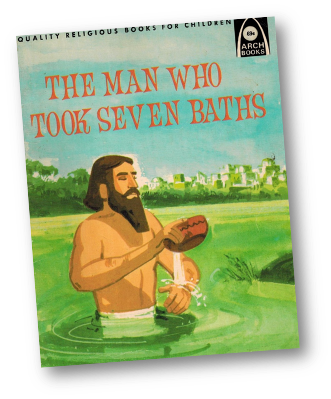
I have mentioned before that one of my favourite storybooks as a child was the Arch book about Naaman: The Man Who Took Seven Baths. I would ask for it to be my bedtime story so regularly that I knew it off by heart. My parents got so bored with reading it that they started changing words and I would tell them when they got it wrong.
It’s a good story. I am really grateful for those who helped me appreciate the Bible. I am really grateful to those who have taught me from it and about it.
But this time around as I read and prayed and prepared for Sunday I found that instead of just reading it at face value I was finding deep themes to explore.
There’s a captured Israelite slave girl at the start of the narrative who tells Naaman to go to Elisha (in enemy territory, her home) in order to be healed. In the past I have skated past this, while admiring her faith.
But she’s a victim of people-trafficking. She’s a slave. That she still has faith in God is remarkable in the circumstances, bearing in mind all she has experienced. We need to honour and respect her and recognise that her experience is still the experience of many across our world today. What are we doing about it?
And that’s before we have even begun to consider Naaman and Elisha and what God might be saying to us through them!
55 or so years after I first read The Man Who Took Seven Baths, the Bible means even more to me than it did then. But my reading of the Bible is changing. In earlier days it felt more like a user manual for God – telling you how to engage with him, how to live to please him, what he thinks about lots of stuff, and most of all telling us about Jesus.
I still don’t think those things are untrue. But there’s so much more that I missed by only treating the Bible like that.
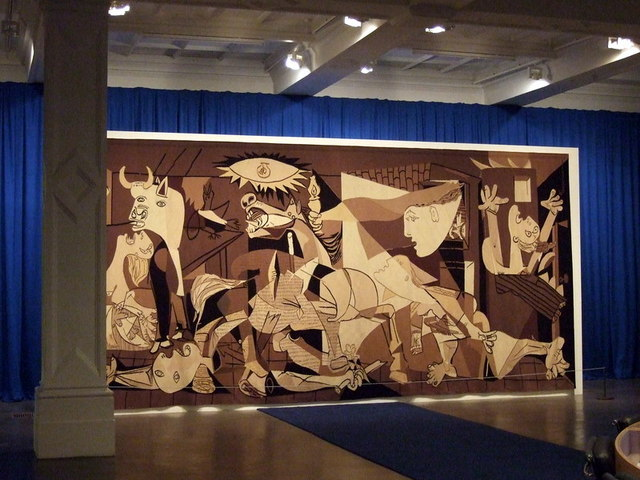
Perhaps it’s also a vast canvas on which God has painted a picture for us. You can look in detail at it, because it’s so intricately painted, but if you focus so much on little details you miss the big picture, the grand themes, the scope and size of it. And if you only look at the details without the big picture, grand themes, scope and size of it, they may look different than the artist intended. For example,if you focus on just the top left corner of Pablo Picasso’s Guernica you may think it’s about cattle, not the horrors of war.
Perhaps there are aspects of a historical feature film in which we see ourselves represented by the different characters. But if we try to see it as set in our 21st century culture we will miss much of what was happening, and misunderstand a lot more. This familiar quote from Gladiator doesn’t make as much sense out of the context of the Roman Empire: “My Name Is Maximus Decimus Meridius, Commander Of The Armies Of The North, General Of The Felix Legions And Loyal Servant To The True Emperor, Marcus Aurelius. Father To A Murdered Son, Husband To A Murdered Wife. And I Will Have My Vengeance, In This Life Or The Next.”
Maybe it’s like a city that has been established with many different buildings that have many different purposes – you don’t use the swimming baths as a marketplace. If you look from the air, you can see how the city planners thought things through and you can see the important parts of the city, but when you get down to street level your view will be dominated by the surrounding buildings or facilities.
Could it be that it’s like a library, with a range of different books. Some are reference books. Some are history books. Some are biographies. Some are records of letters. Some are like the Narnia stories that have layers of meaning behind the story. Of course, that’s actually what we have, isn’t it? The word ‘Bible’ literally means ‘the books’ and it’s intended as a library. But how often do we recognise the different forms of literature contained within it? Do we sometimes misread poetry as prose? Do we forget that there was a purpose for which it was written down at the time, as well as it being relevant to us today? Do we try to make 21st Century concepts fit into ancient near-eastern manuscripts?
I know that some Christians may find this approach unsettling, or deem me to be heretical because of it. Some may question my orthodoxy. Some may even want to argue with me. To be honest, I rather like the idea of being branded unorthodox, radical and wrong by those people. I feel like I am in good company with the one that the religious people branded a heretic for the way he lived the Bible’s teaching – they crucified him for it.

 nukelearfishing
Leave a comment