For almost all of human history we have stayed close to where we were born. Travel was on foot, latterly on horses or other animals. To get anywhere further away than the visible horizon took ages. Until tracks and roads were established navigation was by reference to the sun (if you could see it) by day and the stars by night. It would have been a hit and miss affair. And even after roads came along, until the invention of road signs and the ability to read them it still wasn’t easy to get where you wanted to get. And travelling was a dangerous affair because of the risk of robbery.
In the 19th century all this began to change with the invention of the steam locomotive and railways. Now long distances could be travelled safely and in relative comfort, and if you got on the right train you should get to where you wanted to go. From there the sky’s the limit.
Well it was until the early 20th century when powered flight took off. The development of the aeroplane over the previous century was phenomenal – from flimsy biplanes that looked like big kites someone had strapped an engine to, right up to Concorde that could fly at twice the speed of sound and cut the journey time from London to New York to about 3 and a half hours (it’s now about 8 – progress!). And we’ve flown rockets to the moon and sent space probes to the outer reaches of our solar system.
I’m interested in how inventions develop. They are usually dependent on previous or parallel inventions. Robert and George Stephenson’s Rocket steam train was not possible until James Savery, Thomas Newcomen and James Watt had invented and improved the static steam engine.
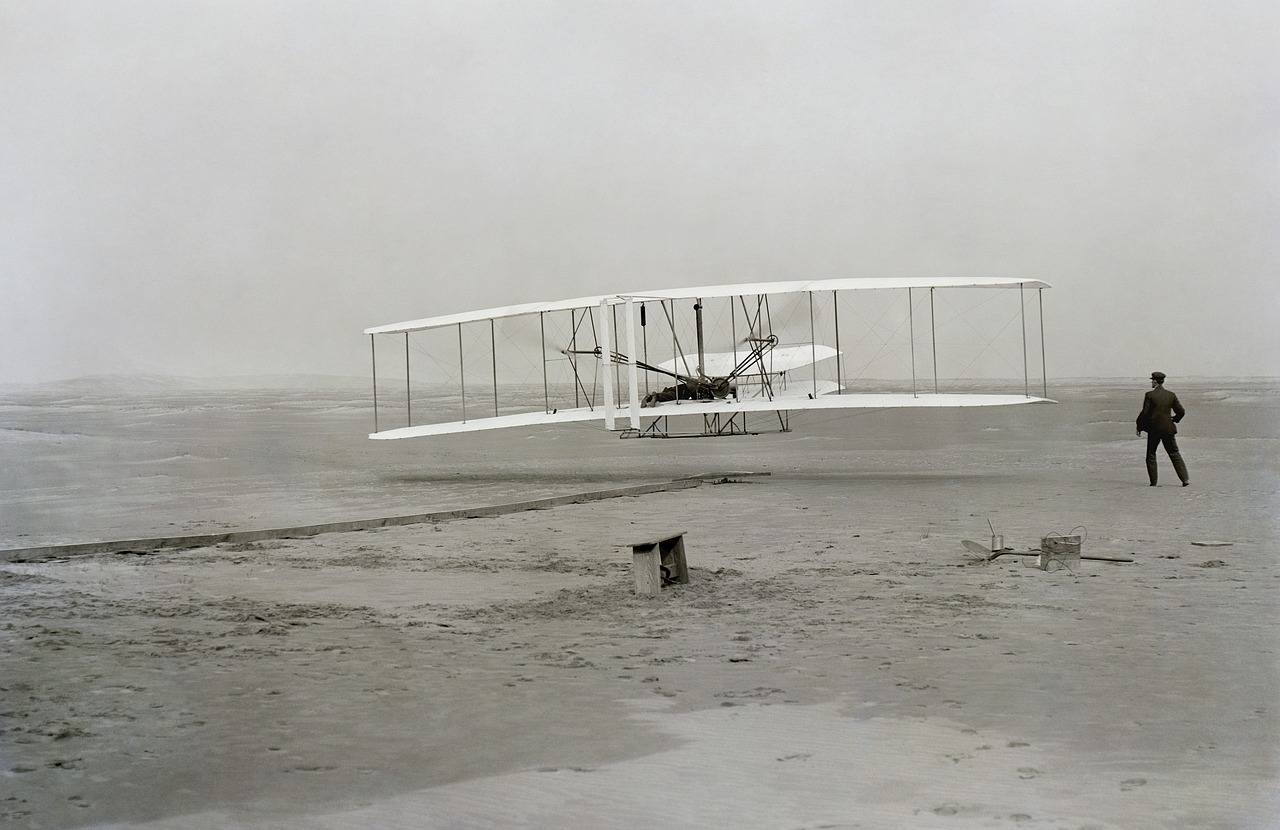
The powered aeroplane was not possible until someone had invented an engine that was powerful enough to power the Wright brothers into the air but light enough to be carried and the Wright brothers added control to aerofoil wings that Sir George Cayley had originally invented a century before, copying the design of bird wings.
As human beings we develop in a similar way. We grow and learn and develop – almost always dependent on the work of others. Parents and carers nurture and feed us from birth. Teachers help us to learn how to learn. Our personality develops as we interact with others.
And I reckon our understanding of God is like that too. We grow and learn and develop in interaction with God and other people. When I think about how naive and yet how certain I was in what I believed when I went to Bible College to train as a Minister I cringe. I had a fixed view of God that I had received from others, but hadn’t thought through (or if I am honest prayed through) myself.
At Bible College one of the best things they did for me was to knock away the certainty and fixed views that I had received (very unsettling at the time) and give me the tools to help me to learn how to learn about God. What I believe and understand now is very different from what I believed and understood when I left Bible College and took my place as a minister in a local church. (A well-meaning church member told me after I had been there a few years that my sermons were much better than when I started. I think he was being encouraging…).
I expect the process of learning about God is something that will continue until my last breath. I hope so because my finite brain can’t hope to contain all there is to know about God.
Being a Christian is not (or I think should not) primarily be an intellectual process – how much do you understand? It’s about knowing God much more than knowing about God. So I also hope and expect the process of getting to know and love God more will continue until and beyond my last breath.
Be blessed, be a blessing


Leave a Reply