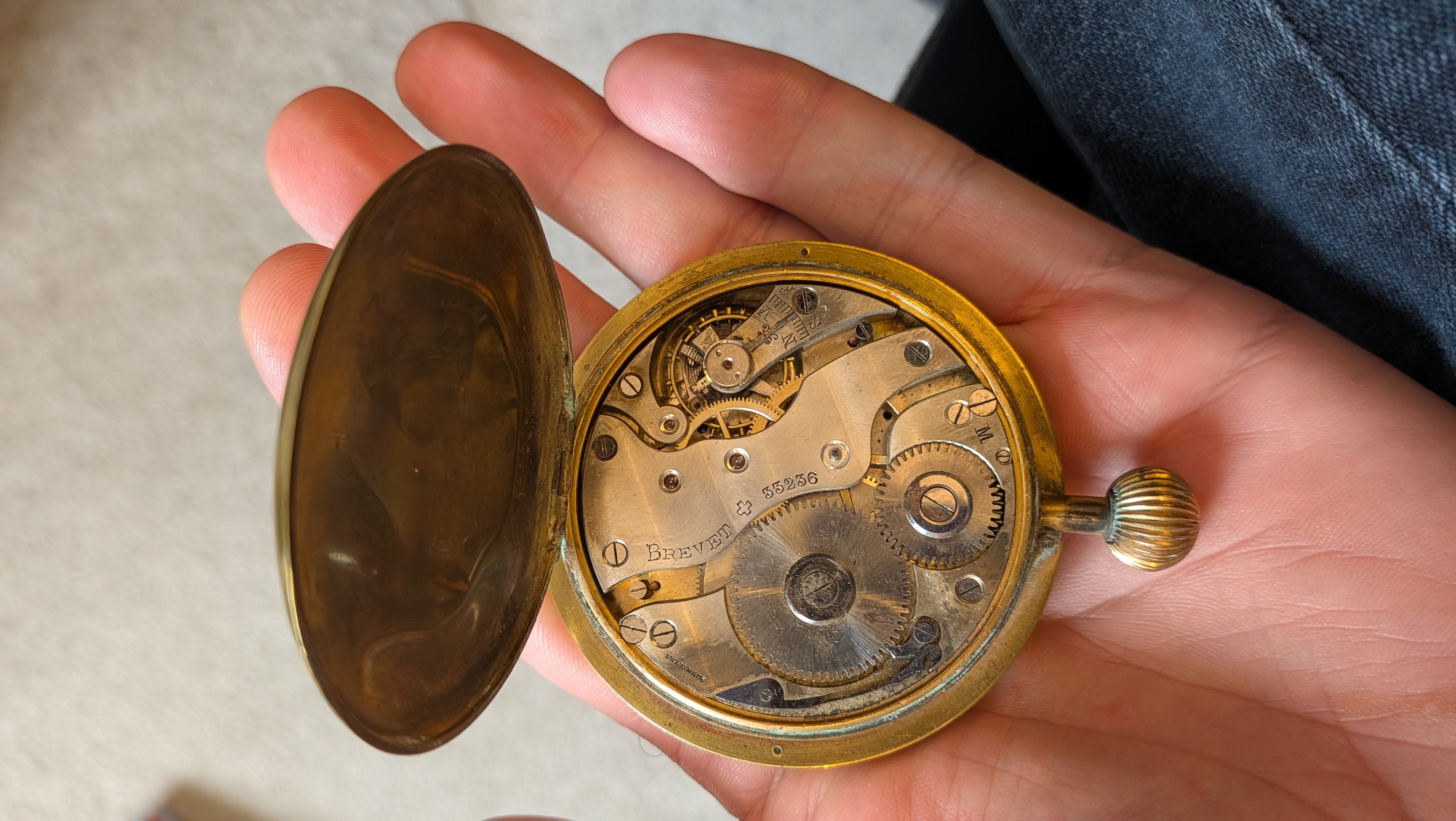
Recently my mother gave me a watch that had belonged to my Great Grandad, Percy. It’s not currently working and I would like to get it repaired (but that’s not what this bloggage is about). It’s not particularly valuable (I’m pretty sure it’s brass, not gold), but it means a lot because it was his.
He was a trench engineer in World War 1 and he had it with him through that conflict. He had it with him his whole life. I can remember sitting with him as a very small boy and him telling stories he’d made up about a duck called Willy Waddle and his sisters. Since receiving the watch I have started to remember what it was like visiting Great Grandad and Grandma’s house, even some of the smells, and how tidy the garden was. I can remember how his garden path was lined with candy twist terracotta edging. I don’t remember Great Grandad having the watch (although my mum does) but it makes me feel closer to him somehow.
And that’s what makes this watch special – it’s the value of the memories it evokes.
We humans have the ability to attach immense sentimental value to inanimate objects, don’t we? You just have to look at the reactions of people on BBC Repair Shop when a previously broken item has been restored. Tears, laughter, comments like ‘it brings it all back’ and so much more mark the moment when people are reunited with their special object.
Sometimes the objects are valuable, but often they’re just ‘ordinary’ items that have immense personal value because of who owned it, used it, held it, touched it. Somehow these things almost enable a connection with someone who’s no longer around. That’s the sort of value that’s impossible to insure because it’s ethereal, even mystical, but intangible. It makes these things priceless and irreplaceable for us: even if we found something identical to replace it if damaged or lost. It’s just not the same because our loved one didn’t own it.
Of course that’s silly, isn’t it? There’s no physical or spiritual connection here. It’s just us being emotional.
But who’s to say that emotional connections aren’t real? Isn’t that part of the essence of love – it’s an emotional connection between people?
I think that we also attach a similar spiritual connection to places of spiritual significance for us. It may be a church building where we had a close encounter with God (which may explain why some people struggle when a church has a renovation project); it may be a place in a nature where we felt close to God. It may not be geographical: it could be a song or Bible passage. But those things remind us of the connection we have had with God and we cherish them.
That’s Biblical. Many places and people in the Bible had their names changed in order to mark an encounter with God, a special moment of faith. It’s why the people of God in exile in Babylon were so distraught when they remembered how Jerusalem was in ruins – and why they wrote Boney M songs*:
By the rivers of Babylon we sat and wept
when we remembered Zion.
There on the poplars
we hung our harps,
for there our captors asked us for songs,
our tormentors demanded songs of joy;
they said, ‘Sing us one of the songs of Zion!’
How can we sing the songs of the Lord
while in a foreign land?
I wonder what places, songs, Bible passages (or anything else) take you back to a special moment of encounter with God.
How did it feel?
How do you feel now as you recall it?
What will you say to God about it?
Be blessed, be a blessing
*It’s the start of Psalm 137, but was made popular in a disco song by Boney M in 1978


Leave a Reply